You Don't Need a Degree to Be an Artist — The Streets Already Knew That

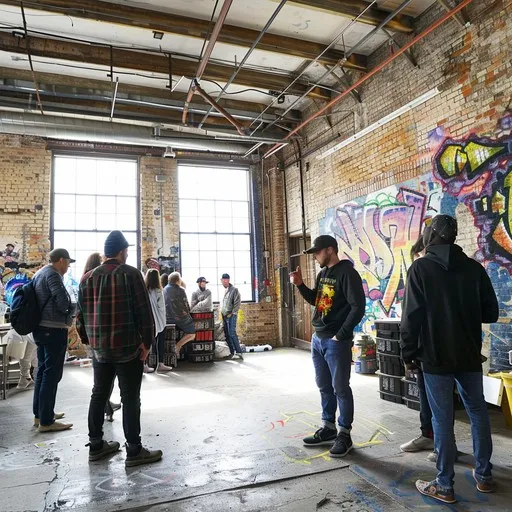
Photo by Photo by Mona Rivas on Unsplash on Unsplash
Somewhere in America right now, someone is standing at an open mic for the first time, hands shaking, about to read a poem they've never shown another living soul. And when they finish — when the room snaps its fingers or claps or just sits in that particular charged silence — something happens to them. Something shifts.
They start to think: maybe I'm a poet.
No institution gave them that. No admissions committee reviewed their portfolio. No professor pulled them aside after class. A room full of strangers did it, for free, on a Tuesday night.
This is the quiet revolution happening inside basements, community centers, pop-up galleries, and Discord servers across the country. And it raises a question worth sitting with: who actually gets to decide who's an artist?
The Old System and Its Very Loud Gatekeepers
For a long time — and still, in many circles — artistic legitimacy ran through a pretty narrow channel. You got a degree from the right school. You got reviewed in the right publication. You got into the right gallery, the right festival, the right grant cycle. The credentials were expensive, often exclusive, and almost always easier to access if you already had money, connections, and the kind of cultural fluency that tends to come with both.
This isn't a conspiracy theory. It's just how credentialing systems work. They replicate the conditions of their own creation.
The result: a lot of genuinely talented people spent years — sometimes entire creative lifetimes — waiting for permission that never came. Or never felt like it fully applied to them.
What Grassroots Spaces Actually Do
Community workshops, open mics, artist collectives, and informal creative gatherings have always existed alongside formal institutions. But something has shifted in recent years. These spaces aren't just filling gaps anymore — they're actively building alternative frameworks for what it means to be a working, recognized creative.
Take the proliferation of community-run zine fests, which have exploded in cities like Detroit, Austin, Minneapolis, and Oakland. These events don't just sell zines. They confer a kind of status. Getting a table at a well-regarded zine fest, being invited to contribute to a collective publication, being asked to facilitate a workshop — these are credentialing moments. They just don't look like the ones hanging on gallery walls.
Or consider the open mic circuit. In many cities, a thriving open mic scene functions as a genuine career pipeline — not just for exposure, but for community recognition that translates into bookings, collaborations, and eventually, income. The host who invites you back, the regulars who start following your work, the other performers who cite you as an influence: these are forms of validation with real weight.
"I've been on panels at universities," says Kezia, a spoken word artist based in Atlanta who has never pursued formal arts education. "Nobody in those rooms asked where I went to school. They asked about my work and my process. The community built that for me."
But Let's Be Honest About the New Hierarchies
Here's where it gets complicated, because this is an opinion piece and we're not going to pretend otherwise.
Alternative credentialing systems can be liberating. They can also just be gatekeeping with better aesthetics.
Every community has its insiders. Every scene has its taste-makers, its unspoken rules about what counts as legit, its quiet mechanisms for including some people and leaving others on the periphery. The open mic circuit that feels welcoming to one person can feel cliquish and impenetrable to another. The artist collective that talks a big game about accessibility can still skew heavily toward people with free time, transportation, and social capital.
This isn't a reason to dismiss what grassroots spaces are building. It's a reason to hold them accountable to their own stated values.
The most honest version of this conversation acknowledges that democratizing art-making is genuinely hard work — not a vibe, not an aesthetic, not just a matter of removing the formal application process. It requires active, ongoing attention to who's in the room and who isn't, and why.
What "Permission" Actually Means
The title of this piece is a little provocative on purpose. Because the truth is, nobody needs permission to make art. People make art in circumstances that would make any arts administrator faint — without funding, without space, without institutional support, without anyone telling them it's okay.
What grassroots communities offer isn't really permission. It's witness. It's the experience of making something and having it received by people who care. That's different. That's actually profound.
And for a lot of people — particularly those who've been historically excluded from formal arts institutions, whether by cost, geography, race, disability, or just not fitting the particular mold a given program was designed around — having that witness in a community context is the difference between continuing to make work and quietly giving up.
That matters. A lot.
The Question Worth Keeping Open
So are underground communities and informal collectives democratizing creative legitimacy? Mostly yes, with significant caveats. Are they sometimes creating new invisible hierarchies? Also yes, and the good ones know it and are actively wrestling with it.
The more useful question might be: what does it feel like to walk into your local creative community for the first time? Does it feel like a door opening or a test you might fail?
If it's the latter, that's worth fixing — regardless of how many formal institutions the space is trying to push back against.
The goal isn't to replace one credentialing system with another. It's to build something more genuinely porous. More honest about its own power dynamics. More committed to the idea that art-making belongs to everyone who wants to do it.
A room full of strangers on a Tuesday night already knows how to do this. The question is whether we can hold onto that energy as communities grow, gain influence, and start to matter in ways that attract exactly the kind of gatekeeping impulses we were trying to escape in the first place.
Stay scrappy. Stay honest. Keep the door open.