So Popular It Hurts: The Uncomfortable Truth About Creative Communities That Got Too Good at This
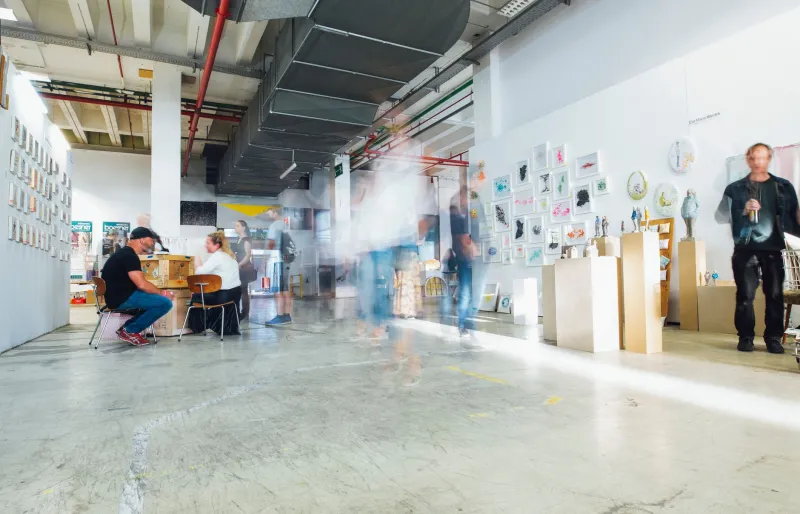
Somewhere in Portland, a ceramics collective has a waiting list longer than most college waitlists. In Chicago, a community theater group stopped accepting new member applications eighteen months ago and hasn't reopened them since. A printmaking studio in Durham is quietly turning away dozens of applicants every quarter — not because they want to, but because they genuinely don't know what else to do.
This is the curse nobody talks about when they're romanticizing the scrappy little art space that could. Success, it turns out, comes with its own brutal set of problems.
The Dream That Outgrew Itself
Most creative communities don't start with a business plan or a membership strategy. They start with a folding table, a shared Google Doc, and three people who really needed somewhere to belong. The whole point is openness — a radical, slightly chaotic belief that art is better when more people are making it together.
And then it works. Word spreads. The Instagram following climbs. Someone writes a glowing piece in a local alt-weekly, or a TikTok goes mildly viral, and suddenly the inbox is full of strangers who desperately want in.
This is the inflection point that breaks a lot of communities — not from failure, but from the weird vertigo of unexpected success. The founding ethos was everyone is welcome, but the practical reality is that a screen-printing studio with four presses and twelve members doesn't have room for forty more bodies without becoming something entirely different.
"We had to reckon with the fact that our identity was built on accessibility," says one organizer of a Brooklyn-based zine collective (who asked to remain anonymous because, as she put it, "the waiting list situation is genuinely embarrassing to talk about publicly"). "And then suddenly we were the gatekeepers. That felt awful. It still feels awful."
Lottery Systems, Caps, and Other Imperfect Solutions
Communities hitting this wall tend to reach for one of a few tools, none of which are particularly satisfying.
Membership caps are the most common first move — just deciding that 40 members, or 60, or whatever the space can reasonably hold, is the ceiling. Simple in theory. In practice, it means maintaining a waiting list that can stretch for years, which creates its own weirdness. People at the bottom of a two-year list aren't really waiting — they've moved on, forgotten they applied, or found somewhere else to belong.
Lottery systems feel more democratic and a little less like the velvet rope at a club you never wanted to go to anyway. Some groups have started doing annual or biannual open lotteries for a small number of new spots, which at least gives the process a kind of randomized fairness. But critics of this approach — and there are plenty — argue that a lottery doesn't account for what someone brings to the community. It turns belonging into a scratch ticket.
Cohort-based intake is gaining traction in some circles: instead of rolling admissions, a community opens up a fixed number of spots a couple times a year, onboards that group together, and lets them find their footing before the next wave arrives. The upside is that new members develop relationships with each other before being dropped into an established social ecosystem. The downside is that it can make a community feel more like a class than a collective.
And then there's the option nobody loves to say out loud: deliberate gatekeeping — actually evaluating applicants based on what they create, what they contribute, or how they fit the community's culture. This is the approach that makes progressive-minded arts organizers the most uncomfortable, for obvious reasons. Creative gatekeeping has a long and ugly history of keeping out exactly the people who most need access to community and resources.
The Ethical Tangle at the Center of All This
Here's the thing that makes this conversation genuinely hard: the communities wrestling with these questions usually aren't trying to be exclusive. They're trying to protect something fragile.
Intimacy is a resource. Trust is a resource. The particular magic of a room where everyone knows each other's work, where feedback is honest and generous because it's built on actual relationship — that's a resource that doesn't scale cleanly. Add too many people too fast and you don't get a bigger version of the same thing. You get a different thing entirely.
"We've watched other groups go from feeling like a kitchen table to feeling like a conference room," one member of a Seattle fiber arts collective told us. "We're trying not to do that. But I'm also aware that there are people on our list who need this more than I do. That's a hard thing to sit with."
The equity dimension here is real and uncomfortable. Waiting lists disproportionately favor people who have the patience and stability to wait — which tends to mean people who already have other options. If your community is committed to centering artists from marginalized backgrounds, a two-year waitlist is a structural barrier that undermines that commitment, regardless of your intentions.
Growing Out Instead of Up
Some communities are finding a third path: instead of managing scarcity, they're trying to manufacture abundance.
A handful of groups have started deliberately spinning off satellite chapters — not franchises exactly, but encouraged offshoots that share values and maybe some resources while operating independently. The original community stays small and weird; the new one gets to build its own culture from scratch. It's messier than it sounds, but it sidesteps the scaling problem by refusing to scale at all.
Others are investing in documentation and open-sourcing their model — publishing their community agreements, their onboarding processes, their conflict resolution frameworks — so that people who can't get in can at least get the tools to build something comparable somewhere else. It's a generous move, and a quietly radical one. You're not saying "come join us." You're saying "here's how to make your own version of this."
There's No Clean Answer Here
If you were hoping this piece would end with a tidy framework for managing your waitlist ethically and efficiently, we're sorry to disappoint. The honest answer is that there isn't one.
What there is: a growing number of creative communities doing the hard work of asking these questions out loud, in public, with their members — not just behind closed doors with the founding circle. That transparency doesn't solve the problem, but it does something almost as important. It keeps the community honest about what it values, and who it's actually for.
The waiting list isn't just a logistics issue. It's a mirror. And what it reflects back at you — about access, about growth, about what "community" actually means when resources are finite — is worth looking at directly, even when it's uncomfortable.
Especially then.