Nobody Handed Them a Microphone — They Built Their Own
There used to be a very specific phone call that mattered. The one from a magazine editor, a record label A&R rep, a gallery director, a newspaper arts columnist. That call meant you were real. It meant your work had been weighed against some invisible standard and found worthy of an audience. Without it, you were basically shouting into a void.
That phone call is becoming a relic. And the people who used to make it are scrambling to figure out what they're even for anymore.
The Old Velvet Rope and Who It Was Really Keeping Out
Let's be honest about what institutional gatekeeping actually looked like in practice. It wasn't just about quality control — it was about access, relationships, geography, and frankly, who looked like the people already inside the room. The communities most consistently locked out of mainstream arts coverage weren't lacking talent or vision. They were lacking the right zip code, the right connections, or the right willingness to sand down their edges to fit someone else's idea of what was marketable.
Grassroots creative movements have always existed on the margins. But before social media, staying on the margins meant staying small. A mural collective in South Phoenix, a spoken word scene in Memphis, a queer performance art community in rural Ohio — these things happened, mattered deeply to the people involved, and then largely disappeared from the broader cultural record because no one with institutional reach decided to write them down.
The internet changed the math. Social media changed it again, harder.
When the Algorithm Becomes the A&R Rep
Somewhere around 2012 or so, something shifted. Platforms like Tumblr, then Instagram, then TikTok started doing something that no magazine ever had: they let audiences self-organize around work they loved, without waiting for permission. Fan communities exploded. Niche aesthetic movements found each other across state lines. Artists who'd been told their work was "too specific" or "too weird" discovered there were tens of thousands of people who'd been waiting exactly for that specific weirdness.
The case of the natural hair movement is one of the cleaner examples. Black women sharing hair care tips, styling tutorials, and frank conversations about texture and identity built an entire cultural conversation on YouTube and Instagram that the mainstream beauty industry had actively ignored for decades. No Vogue feature launched it. No network television segment validated it. It grew because it was genuinely useful and genuinely resonant — and because peer-to-peer sharing turned individual voices into a chorus.
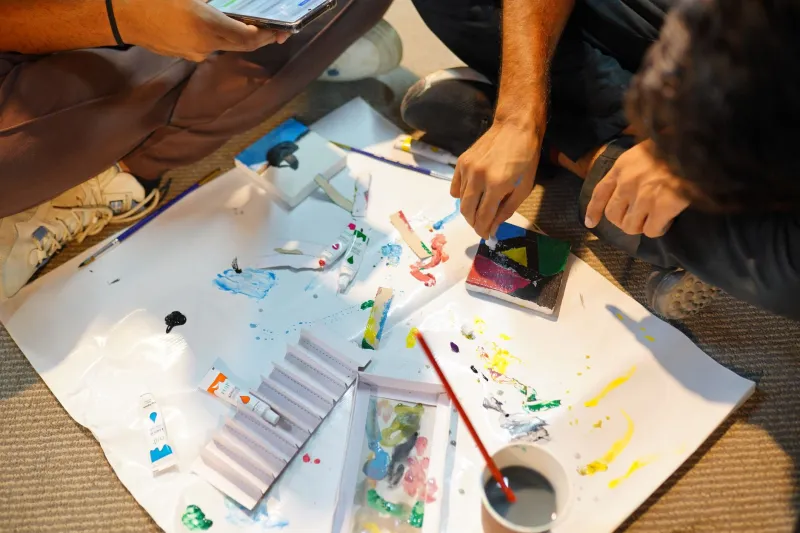
Same story with the DIY zine revival that exploded on Instagram and later TikTok's #BookTok adjacent communities. Same story with the muralism renaissance that's been quietly reshaping neighborhood identity in cities from Detroit to Albuquerque. Same story with the mutual aid art collectives that emerged during the pandemic and used Instagram not just to share work but to coordinate real-world support for struggling communities.
None of these needed a gatekeeper's blessing. They needed an audience willing to share.
The Liberating Part (And the Part That Keeps You Up at Night)
Here's what's genuinely exciting: creative communities can now build their own infrastructure of legitimacy. A collective in Cleveland doesn't need a New York Times arts section write-up to matter. They can document their own work, build their own following, speak directly to the people they're actually making things for. That's not nothing. That's actually enormous.
Authenticity travels differently now. Audiences — especially younger ones — are remarkably good at detecting when something is being performed for institutional approval versus when it's coming from a real place. The DIY aesthetic isn't just a look; it's a trust signal. It says: we made this because we had to, not because someone green-lit it.
But. And this is a real but.
The absence of gatekeepers doesn't mean the absence of power dynamics. It just means the power dynamics got weirder and harder to see. Algorithms are not neutral. They reward engagement, which often means they reward outrage, simplicity, and visual spectacle over nuance, complexity, or slow-burn community building. The movements that go viral aren't always the ones with the most to say — sometimes they're just the ones that hit the right emotional register at the right moment.
There's also the exhaustion factor. When your creative community is also responsible for its own media strategy, its own documentation, its own amplification — that's a second full-time job on top of the actual making. Smaller collectives with fewer resources burn out trying to keep up with content expectations that were basically designed for organizations with marketing departments.
And then there's the fragmentation problem. When everyone has a microphone, the conversation gets loud and hard to follow. Movements that might have coalesced around a shared message can splinter into competing factions, each with their own platform presence and their own version of the story. That's sometimes healthy pluralism. It's sometimes just chaos.
What the New Legitimacy Actually Looks Like
What's emerging in the most resilient creative communities isn't a rejection of all editorial infrastructure — it's the building of alternative infrastructure. Community newsletters. Collective-run podcasts. Locally produced documentary series shared on YouTube. Regional arts blogs with actual editorial standards and actual accountability to their communities rather than to advertisers or parent companies.
Think of it less as "no gatekeepers" and more as "different gatekeepers" — ones who are accountable to the community itself rather than to external institutions. The Portland zine fest doesn't need The Atlantic to cover it to be culturally significant. But it does benefit from the people who show up every year writing about it, documenting it, arguing about it, keeping the memory of it alive in forms that new people can find.
That's a kind of editorial work too. It's just distributed, community-held, and operating on different incentives.
The Mic Is Yours — Now What?
The democratization of creative voice is real and it's worth celebrating without qualification. The idea that a small collective of artists in a mid-sized American city can build a genuine audience, tell their own stories, and influence the broader cultural conversation without anyone's permission — that's a genuinely new thing in the world, and it matters.
But having access to the microphone is only the first part of the question. What you do with it, how you sustain the energy to keep using it, how you build community rather than just content — that's where the real work is. The gatekeepers being gone doesn't mean the work got easier. It means the work got more honest.
And honestly? For the creative communities that have always had the most to say and the least institutional support to say it — that trade-off feels pretty worth it.