Both Right, Both Stuck: What Happens When Two Creative Visions Refuse to Blink
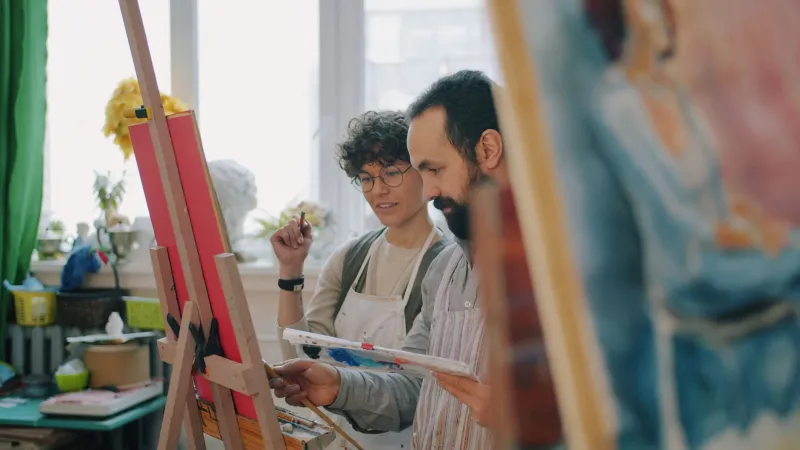
There's a moment that almost every creative partnership hits eventually. You're deep into a project — a mural, an album, a community theater production, a zine — and you realize that your collaborator isn't just suggesting something different. They're suggesting something fundamentally different. Not a tweak. A turn. And suddenly the thing you've been building together feels like it's standing at a fork in the road, with both of you on opposite sides of it.
This is the collaboration paradox. Two people, both genuinely committed, both creatively serious, both probably right about something — and completely unable to move forward together. It's one of the most common reasons creative partnerships fall apart. It's also, weirdly, one of the most powerful forces that can push a collaboration into genuinely original territory.
The question isn't whether the conflict will happen. It will. The question is what you do when it does.
The Myth of the Seamless Partnership
We have this cultural fantasy about creative duos — Lennon and McCartney finishing each other's sentences, Beyoncé and a producer in perfect harmonic sync, two muralists dipping their brushes in unison. The reality is almost always messier, and that mess is usually the point.
John and Paul famously clashed over the direction of the Beatles' later work. The tension between McCartney's melodic pop instincts and Lennon's experimental restlessness didn't just produce conflict — it produced Abbey Road. The friction was the engine. Neither one of them, working alone, would have made the same thing.
Closer to home, think about the community theater groups, local music collectives, and indie art spaces where this plays out every single week. The director who wants the production to be political and the choreographer who wants it to be beautiful. The graphic designer who loves stark minimalism and the community organizer who wants color and warmth everywhere. These aren't petty disagreements. They're philosophical ones. And that's exactly why they're worth taking seriously instead of papering over.
Why Deadlocks Are Actually Data
Here's a reframe that a lot of creative collaborators find useful: when you hit a genuine impasse, that's not a sign that something is broken. It's information. Specifically, it's information about what each person values most — and what the project hasn't yet figured out how to hold.
In Nashville, a pair of independent musicians who'd been playing together for years hit a wall while recording their second album. One wanted to go rootsier, more stripped-back, leaning into Americana influences. The other was hearing something more experimental, layered, and genre-blurring. They spent two sessions just arguing about it. Eventually, a producer friend suggested they stop trying to resolve the argument and instead make a record about the argument. The resulting album — structurally split between the two visions, with songs that literally traded off aesthetics — became the most critically interesting thing they'd ever released. The deadlock was the concept.
Not every conflict resolves this neatly. But the principle holds: before you try to win the argument, get curious about what the argument is actually telling you.
Frameworks That Actually Help
So what do you do when you're in it? When the collaboration has stalled and both people feel like they'd be betraying something essential if they gave ground?
Name the values, not just the preferences. Most creative disagreements look like aesthetic debates on the surface — color versus black and white, abstract versus representational, loud versus quiet. But underneath, there's almost always a values conflict. One person wants the work to feel accessible; the other wants it to feel challenging. One wants the community to recognize themselves in it; the other wants to push the community somewhere new. When you name the underlying value, you have something to actually negotiate with.
Try the 'yes, and' before the 'no, but.' Borrowed from improv comedy, this practice is genuinely useful in creative conflict. Before you explain why the other person's idea won't work, spend five minutes building on it as if it might. You'll often find something salvageable inside the idea you were about to reject — and your collaborator will feel heard enough to return the favor.
Give each vision a real audition. This is harder and slower, but it works. Instead of debating in the abstract, actually prototype both directions. Sketch them out, storyboard them, demo them. When you can see or hear both visions side by side, the conversation shifts from theoretical to concrete. Sometimes one direction is obviously stronger. Sometimes you find a third thing that neither person initially imagined.
Bring in a trusted outside voice. Not to arbitrate — that usually just produces resentment toward the third party. But a trusted outside perspective can name what's actually happening in the room, reflect back what both people are trying to protect, and sometimes spot the synthesis that neither collaborator can see because they're too close to the fight.
When the Conflict Is a Values Problem, Not an Aesthetic One
Here's where it gets harder. Sometimes the disagreement isn't really about the work at all. It's about whose community the work is for, or what it's willing to say, or what it's willing to risk. A collective in Chicago working on a public art installation split down the middle over whether to include explicitly political imagery. Half the group felt it was essential to the project's integrity. The other half worried it would alienate the very neighbors they were trying to reach.
That's not a design problem. That's a mission problem. And those don't get solved by finding the right shade of compromise — they get solved by getting honest about what the collaboration is actually for.
Sometimes the answer is that two people genuinely aren't making the same thing, and that's okay. A split isn't always a failure. Sometimes it's two projects finding their correct form.
The Friction Is the Feature
The creative communities that seem to handle this best aren't the ones where everyone agrees. They're the ones that have built a culture around productive disagreement — where conflict is expected, named quickly, and treated as part of the process rather than a threat to it.
At TwoOsTwo, we've seen this over and over in the communities we cover and the people we talk to. The most interesting work tends to come from partnerships that had to fight for their direction. Not because suffering is noble, but because when two strong visions actually wrestle with each other, what survives is almost always stronger than what either person started with.
Being stuck isn't the end of the story. It's usually the part right before the interesting part begins.
So the next time you're locked in creative standoff with someone you respect — take a breath. Get curious. The fact that neither of you is willing to back down might mean you've both found something worth protecting. The job now is figuring out how to protect it together.